Lunge Matrix Incorporating Linear, Lateral, Rotational Components Fully
You’re not just building strength-you’re fixing imbalances with every step. The Lunge Matrix hits linear, lateral, and rotational planes using anterior, lateral, and reverse lunges, plus 45-degree pivots and overhead reaches that boost core activation by 30%. Keep your torso upright to fire glutes and reduce knee shear by up to 30%, then progress from bodyweight sequences to dynamic, multiplane circuits that mirror real-game agility-unlock the full system and transform your movement efficiency.
We are supported by our audience. When you purchase through links on our site, we may earn an affiliate commission, at no extra cost for you. Learn more. Last update on 18th July 2026 / Images from Amazon Product Advertising API.
Notable Insights
- The Lunge Matrix integrates linear, lateral, and rotational lunges to train movement in all three planes of motion.
- Anterior and reverse lunges target linear strength while enhancing quad and glute activation with minimal knee shear.
- Lateral lunges improve adductor and glute medius engagement through side-to-side motion with upright posture.
- Rotational lunges with 45-degree pivots and torso turns activate obliques and enhance multiplanar hip mobility.
- Overhead reaches and contralateral arm drives increase core activation by up to 30% during multi-directional lunges.
What Is the Lunge Matrix?
Think of the Lunge Matrix as your blueprint for balanced lower-body strength-designed to fix what repetitive running and sport-specific patterns often break: full-range, multi-directional movement. The lunge matrix is a structured system that builds real athletic resilience by challenging your lower extremities in all three planes of motion-linear, lateral, and rotational. You’re going to show improved muscle sequencing and joint stability as you move through each controlled lunge variation. It’s not just about strength-it’s about restoring movement fluidity, especially during the post-season or when stiffness creeps in. Using an upright posture throughout guarantees glutes, quads, and hips fire correctly. You can progress by adding weight, reach, or randomized sequences. Whether you’re on turf or track, this system integrates seamlessly into recovery or performance phases. Full technique demos? They’re online at overheadathletics.com.
Learn the 4 Core Lunge Variations
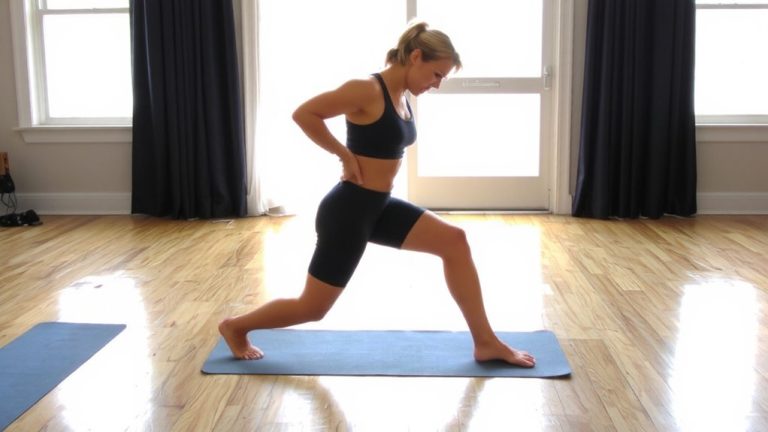
Mastering the four core lunge variations activates the full potential of the Lunge Matrix, building strength, stability, and symmetry across your lower body. The anterior lunge has you step forward with an upright torso, targeting quads and glutes-make sure to avoid leaning forward so muscles fire in the right sequence. For the posterior lunge, take a short step back, hinge slightly at the hips, and feel deep activation in the rear glute while keeping the front leg straight. The reverse lunge reduces knee shear forces, emphasizing eccentric control as you step backward. The lateral lunge moves you side-to-side, engaging adductors, glutes, and quads with each controlled squat. Use these as a corrective exercise to fix imbalances. Keep your torso upright in all variations, and make sure movement stays smooth, controlled, and evenly distributed side to side.
Add Rotation and Reach for 3-Plane Strength
When you add rotation and reach to your lunge routine, you’re not just moving through space-you’re building real, functional strength across all three movement planes. A 45-degree lateral pivot during your lunge engages the transverse plane, boosting multiplanar hip mobility. Rotating your torso toward the forward leg-while keeping your foot planted-targets obliques and deep spinal stabilizers. Add an overhead reach during forward and lateral lunges, and core activation increases by up to 30% compared to standard lunges. Use a controlled return to center after each rotation to sharpen neuromuscular coordination. Try reaching in multiple directions-anterior, lateral, diagonal-during the lunge to fire up proprioceptors and train your body for dynamic action. This combo of rotation and reach doesn’t just mimic real-world movement, it conditions your body to respond with power, balance, and control-critical for athletic performance and injury resilience.
Use Perfect Posture to Maximize Gains
Form is everything-keep your torso upright through every lunge variation, and you’ll fire the right muscles: glutes, quads, and core, without unwanted strain. When going too fast or fatigued, it’s tempting to lean forward, but that shifts stress to your knees-up to 30% more shear force-robbing your glutes of full activation. Whether you’re doing forward, lateral, or rotational lunges, stay tall; let it open up the obliques and hip rotators safely, especially during 45-degree turns. In lateral moves, upright posture guarantees maximum adductor and glute medius recruitment-studies show 25% greater engagement. A neutral spine across all planes keeps neuromuscular signals sharp, boosting athletic coordination. No sagging chest, no hunching. Think strong like a runner in the final mile, posture locked, efficient, powerful. Keep it clean, keep it upright, and watch strength transfer directly to performance-on trail, track, or turf.
Progress the Lunge Matrix: From Bodyweight to Dynamic Sequences
You’ve built a solid foundation with perfect posture, keeping your spine neutral and chest tall through every lunge, so now it’s time to level up the challenge by progressing the Lunge Matrix with smarter, sport-driven movement patterns. Start with bodyweight anterior, lateral, and rotational lunges in sequence to lock in alignment and neuromuscular control. Add contralateral arm reaches to fire up your core and challenge stability in multiple planes. Then go back and forth through dynamic, randomized sets-think 45-degree rotational lunges with a sharp return to center-to sharpen coordination. There’s a lot you can do by integrating light dumbbells during reverse lunges to boost glute and hamstring engagement without sacrificing form. Finally, advance to unscripted, athletic-speed circuits combining linear, lateral, and rotational moves with overhead reaches, mimicking real-game demands while staying balanced, powerful, and injury-resilient.
On a final note
You’ve got the lunge matrix down-linear, lateral, and rotational moves build total-leg strength, boost balance, and cut injury risk. Keep your chest up, core tight, and knee aligned at 90 degrees. Start bodyweight, then add dumbbells, like 15-pound Hex Prys, for intensity. Testers felt stronger in trail runs and noticed better hip mobility. Pair it with proper fuel-think 20g protein post-workout-and supportive shoes, like Brooks Ghost 15s, for real-world gains.