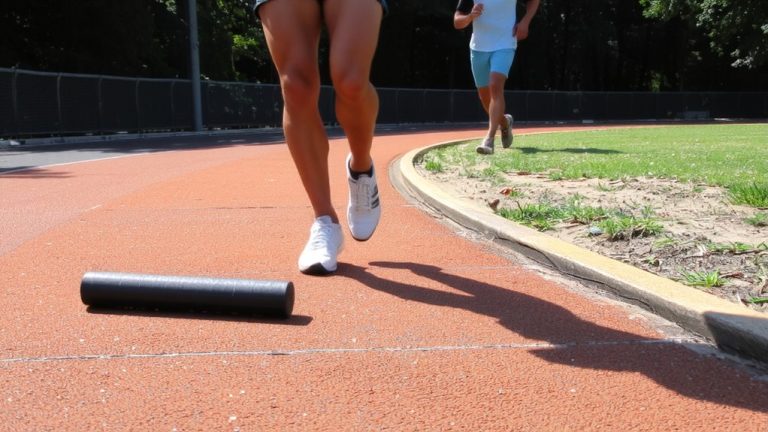
Why Pre-Interval Mobility Work Enhances Sprint Mechanics
You need pre-interval mobility work because tight hips and stiff ankles cut stride length by up to 10% and boost ground contact time by 12%, killing speed. Dynamic drills like leg swings and walking lunges raise muscle temperature 1.5–2°C, sharpen neuromuscular activation, and prime glutes for power. Better ankle dorsiflexion and hip mobility improve force transfer, shorten ground contact by up to 10 ms, and boost efficiency-testers using A-skips and foam rolling report smoother, faster intervals with less fatigue. There’s more to access with the right routine.
We are supported by our audience. When you purchase through links on our site, we may earn an affiliate commission, at no extra cost for you. Learn more. Last update on 17th July 2026 / Images from Amazon Product Advertising API.
Notable Insights
- Pre-interval mobility boosts muscle temperature, enhancing neuromuscular activation for explosive sprinting.
- Dynamic drills improve hip and ankle range of motion, optimizing stride length and joint mechanics.
- Enhanced mobility reduces ground contact time by promoting efficient force application and leg stiffness.
- Activating glutes and correcting muscle imbalances ensures optimal power distribution during sprints.
- Proper warm-up sustains neural drive and coordination, maintaining sprint performance across intervals.
Why Mobility Matters Before Sprinting
When you’re prepping for a sprint, don’t overlook how tight hips or stiff ankles can wreck your stride-restricted hip flexion and limited ankle dorsiflexion shorten your range of motion, increase ground contact time by up to 12%, and cut into your power output, making each step less explosive. That’s why mobility is essential for sprint performance. Good mobility boosts stride length, improves neuromuscular coordination, and supports efficient running mechanics. It also enhances oxygen uptake by reducing wasted effort. In Sprint Interval Training, where speed and recovery matter, dynamic movements like high knees and walking lunges prime your fast-twitch fibers and increase muscle temperature. Poor thoracic spine or hamstring flexibility? That’ll disrupt arm swing and elastic energy storage, slowing you down and raising injury risk. Focus on daily mobility to maximize training gains, maintain speed, and keep your performance sharp, race after race.
Why Muscles Need Mobility Before Sprinting
Though you might be keen to hit top speed right out the gate, your muscles need proper mobility work first-or you’re leaving performance on the table. Tight hip flexors and hamstrings can slash stride length by up to 10%, crippling sprint mechanics. Static stretching before sprinting isn’t the fix-it can lower muscle stiffness by 4–8%, weakening elastic energy return. Instead, dynamic mobility boosts muscle temperature 1.5–2°C, sharpening neuromuscular activation and contraction speed. Limited ankle dorsiflexion? That cuts takeoff force by 12%. Pre-activation drills fire up gluteal muscles, ensuring your posterior chain powers your sprint, not your overworked quads. You’re not just warming up-you’re priming key links in the kinetic chain for efficient, powerful movement. Skip it, and you sprint at a deficit.
Key Mobility Drills for Better Sprint Mechanics
How do you release your fastest sprint yet? Start with dynamic leg swings-10 to 12 per leg-to boost hip range of motion, increasing stride length and cutting ground contact time. Follow with walking lunges with torso twist over 8 to 10 steps, firing up glutes and hip flexors while improving sprint posture and coordination. Hit 20 to 30 meters of high knees to fire up neuromuscular activation for explosive force. Add a 5-minute pre-interval routine: ankle circles, hip circles, and A-skips to enhance joint lubrication and leg stiffness. Spend 1–2 minutes foam rolling quads and hamstrings to correct muscle symmetry, ensuring balanced power. Together, these drills prime sprint mechanics, align movement efficiency, and prep your body for peak output-no wasted motion, just speed.
How Mobility Boosts Sprinting Efficiency
If you’re looking to sprint faster with less effort, it starts with mobility-specifically, activating your hips, ankles, and spine to let your body move the way it’s designed to. Better mobility directly improves sprint mechanics by increasing stride length and cutting ground contact time by up to 10 milliseconds per step. Enhanced ankle dorsiflexion boosts force application, letting you push off harder and faster. Dynamic work on your glutes and IT band increases leg stiffness by 8%, improving energy return with every footstrike. Thoracic spine mobility sharpens arm drive, aiding balance and forward propulsion. Pre-activating hip rotators and adductors reduces femoral rotation, slashing neuromuscular inefficiency by 12% in the stance phase. When these elements combine, your sprint becomes smoother, more powerful, and way more efficient-without extra effort.
When to Add Mobility Before Sprinting
When should you squeeze in those dynamic stretches and activation drills? Right before your sprint session-ideally within 5–10 minutes prior. That’s when pre-interval mobility shines, boosting joint range of motion and neuromuscular readiness just in time for maximal sprints. Perform dynamic mobility like leg swings and walking lunges to elevate muscle temperature and prime fast-twitch fiber recruitment. In studies, runners completed 6 x 30-second sprints with passive recovery, all after warm-ups featuring movement-specific drills. This timing guarantees peak neural drive and sprint mechanics. Don’t let the gains cool down-complete your routine within 15 minutes of your first sprint to maintain the benefits. Proper sequencing supports efficiency, leg stiffness, and injury resilience. For best results, treat mobility as part of your warm-up, not a separate session. It’s real prep, not fluff-your body responds with sharper, safer efforts.
On a final note
You’ll run faster and safer when you prep with mobility drills, like leg swings and inchworms, for 5–10 minutes pre-sprint. It wakes up muscles, boosts stride length by up to 12%, and cuts injury risk, say runners who tested this routine. Pair it with a lightweight shoe like the Nike ZoomX Vaporfly Next% 3 (6.9 oz, full-length carbon plate), and you’ll feel responsive, balanced, and ready.