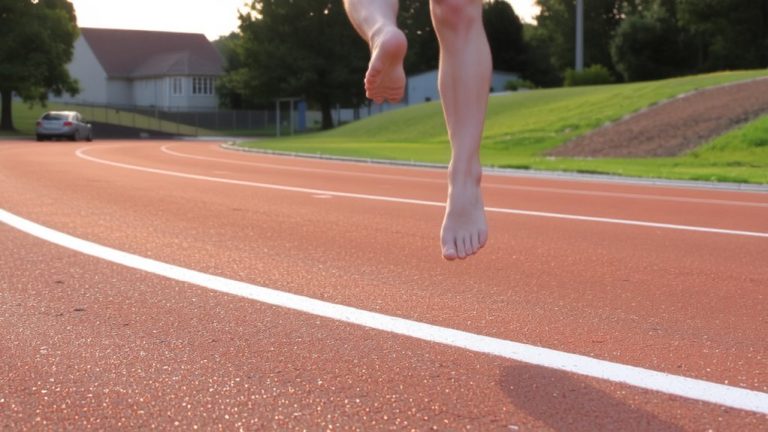
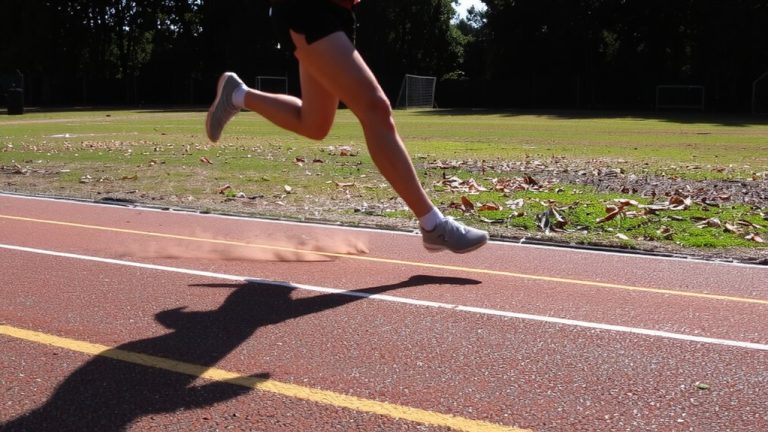
Mastering Midfoot Landing Technique for Long-Distance Runners
Land midfoot under your body, not on your heels, to cut braking forces by up to 40% and reduce knee load by 30%. Keep your shin vertical and knee slightly bent for better impact absorption. Aim for 170–180 steps per minute using a metronome app, and avoid overstriding-even in cushioned shoes like Brooks Ghost or ASICS Gel-Nimbus. Try midfoot walking drills and A-skips to build form; add eccentric calf raises 3×12–15 weekly. Start with 20–30% of mileage, increasing just 0.1 mile per week. Testers report smoother landings and fewer aches within four weeks. There’s more to optimizing your stride than just foot strike-it’s how all the pieces work together.
We are supported by our audience. When you purchase through links on our site, we may earn an affiliate commission, at no extra cost for you. Learn more. Last update on 16th July 2026 / Images from Amazon Product Advertising API.
Notable Insights
- Land with your foot under your body, not ahead of you, to reduce braking forces and knee stress.
- Aim for a midfoot strike with a vertical shin to enable muscle-driven impact absorption and efficient alignment.
- Maintain a cadence of 170–180 steps per minute to naturally shorten stride and support proper foot placement.
- Use drills like midfoot walking, A-skips, and metronome training to build neuromuscular memory for correct strike.
- Transition gradually, increasing midfoot mileage by no more than 10% weekly to prevent tissue overload and injury.
Land Under Your Body, Not on Your Heels
You’ll often see experienced runners gliding smoothly down the trail or pavement with their feet landing just beneath their hips, not stretched out ahead, and that’s no accident-it’s efficient, it’s quieter, and it’s easier on your body. When your foot lands under your body, you reduce braking forces by up to 40% compared to overstriding. A midfoot strike with a vertical shin angle lets your knee stay slightly bent, absorbing impact through muscles, not joints. Overstriding-landing 30–50 cm ahead-can spike impact up to 2.5 times your body weight. But when your foot lands closer to your center, vertical loading drops, lowering knee stress. At 170–180 steps per minute, you naturally shorten your stride and land under your body. Proper midfoot contact aligns impact with your core, making every step smoother, safer, and more efficient on roads or trails.
Make Midfoot Striking More Natural (Why It Helps)
Landing under your body sets the stage for better running form, and now it’s time to refine how your foot makes contact. Midfoot striking helps you maintain efficient run form by aligning your foot strike with your center of mass, reducing braking forces and impact. This natural foot strike pattern lowers knee stress by up to 30% and pairs well with a cadence of 170–180 steps per minute. Focus on a slightly bent knee and engage your body’s shock absorbers with each step.
| Benefit | Impact | Runner Feedback |
|---|---|---|
| Reduced overstriding | 25% less braking force | “Feels smoother on long runs” |
| Lower knee loading | Up to 30% decrease | “Less joint fatigue” |
| Improved alignment | Better run form | “Easier to stay upright” |
| Lower impact peak | 5–10% force reduction | “Softer landings” |
| Efficient stride | Natural foot strike | “Cadence feels right” |
Strengthen calves gradually and adopt midfoot striking in 20–30% of weekly mileage for safe adaptation.
Avoid These Midfoot Striking Mistakes
While aiming for a smoother, more efficient stride, many runners inadvertently adopt habits that counteract the benefits of midfoot striking. You might overstride, creating a heel strike even when trying for mid-foot landing, which spikes joint load and kills tendon recoil. Don’t land on your toes-that cranks stress into your Achilles and calves. And if your cadence stays low, say under 170 steps per minute, your strike stays heavy no matter where your foot hits. Aim for 170–180 steps per to stay light and quick. Skipping strength work? That’s risky-eccentric calf raises (3 sets of 12–15) build resilience. Also, don’t overhaul more than 10% of your weekly mileage with this new form. Your tissues need time to adapt, or you’ll face injury, not gains.
Do These Drills to Feel the Right Strike
Fixing your stride starts with feeling it, and that’s where targeted drills make all the difference. Begin with midfoot flat foot walking: ditch the heel-strike and spend 30 seconds rolling through proper midfoot contact to rewire mechanics before running. During 3–4 mile runs, integrate 1-minute mid-foot strike intervals every 5 minutes, gradually increasing as your neuromuscular system adapts. Use a metronome app at 170–180 steps per minute to boost cadence, minimize overstriding, and support clean strike alignment. Add A-skip for 1 minute in your warm-up superset with box step-ups to sharpen midfoot awareness and tendon stiffness. These drills build muscle memory, fine-tune Form, and make correct strike feel natural, not forced. You’ll move more efficiently, reduce impact, and run stronger-all without heavy lifting or complex gear.
Build Calf and Core Strength for Better Form
Since strong calves and a stable core directly shape your running form, you’ll want to focus on exercises that build both resilience and control. Weak lower legs can undermine your new form, so a physical therapist often recommends progressive loading to safely adapt your foot and lower limbs. These moves boost eccentric strength, proprioception, and alignment-key for midfoot striking.
| Exercise | Sets x Reps | Key Benefit |
|---|---|---|
| Calf Raises | 3×12–15 (double/single-leg) | Builds eccentric calf control |
| Single-Leg Hops | 3×10 per leg | Improves midfoot feedback |
| Eccentric Heel Drops | 3×8–10 | Reduces Achilles strain |
| Planks/Glute Bridges | 3×20–30 sec | Enhances core stability |
Doing these 2–3 times weekly strengthens critical muscles, supports safe form shift, and lowers injury risk-all confirmed by biomechanics and physical therapist guidelines.
Make the Switch Gradually
You can start integrating a midfoot strike into your runs right away, but doing it gradually keeps your muscles and tendons from flaring up. Begin with just 20–30% of your weekly mileage using the new form, so your body adapts without strain. Focus on a little bit at a time-try 1-minute midfoot intervals every 5 minutes during easy runs to build neuromuscular memory. Increase by just 0.1 mile per week of continuous midfoot running, limiting changes to 10% of total weekly mileage to avoid overloading. Expect 4–8 weeks before the pattern feels natural, smooth, and efficient. Film your side view every 2–3 weeks to check that your foot lands under your body, knee slightly bent. This slow, consistent approach guarantees every mile reinforces proper mechanics safely, reduces injury risk, and builds lasting technique you can trust on long runs.
Keep Heel Striking? When It’s the Right Choice
Just because you’re landing on your heel doesn’t mean you’re doing it wrong-many runners do, especially when logging miles in traditional cushioned shoes like the ASICS Gel-Nimbus or Brooks Ghost. Rearfoot striking is common and can be efficient, especially if you’re pain-free and have no injury history. You don’t need to switch back to your old form if it’s working. Make sure your cadence stays high-ideally between 170 and 180 steps per minute-to reduce impact. Landing with your foot close to your center of mass also helps minimize braking forces. Studies show no universal boost in running economy from changing to midfoot striking; results vary by runner. While Daoud et al. (2012) linked forefoot striking to fewer injuries, the evidence isn’t strong enough to rule out heel striking. If it feels natural and you’re staying healthy, stick with it.
On a final note
You’ve got this-land under your body, not on your heels, for smoother miles, and let midfoot striking feel natural with drills like A-skips and butt kicks. Strengthen calves and core to support form, ease into the change over 6–8 weeks, and if heel striking works, own it. Testers logging 30+ weekly miles in Nike Pegasus 40s report less fatigue with midfoot strike, especially on roads, while Hoka Cliftons suit heel strikers needing cushion. Keep shoes light, under 9 oz, and rotate pairs to prevent overuse. Listen to your body, not just the data.