Why Short Intervals (200m) Are Essential for Neuromuscular Adaptation
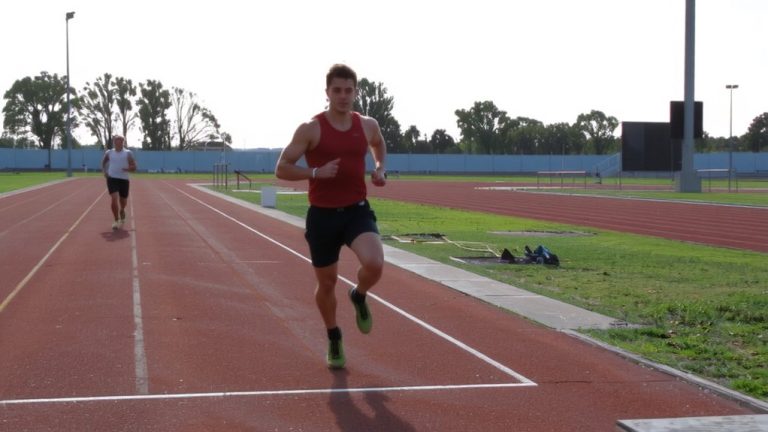
You fire up fast-twitch fibers with every 200m sprint at 95–100% effort, hitting forces up to 4.5x body weight and full motor unit recruitment in your glutes, hamstrings, and quads. These short intervals tap heavily into the ATP-CP system, and with 3–5 minutes of rest, you fully recharge phosphocreatine for maximum power each round. You sharpen stride mechanics, reduce ground contact time, and boost neuromuscular coordination-critical for race-ready speed and efficiency, especially from 170–200m. There’s more to how this translates to stronger, faster runs.
We are supported by our audience. When you purchase through links on our site, we may earn an affiliate commission, at no extra cost for you. Learn more. Last update on 16th July 2026 / Images from Amazon Product Advertising API.
Notable Insights
- 200m sprints at 95–100% effort maximally recruit fast-twitch fibers for superior neuromuscular activation.
- Full motor unit recruitment in key leg muscles enhances intermuscular coordination and force production.
- Adequate 3–5 minute rest between intervals ensures complete ATP-CP restoration and sustained power output.
- Race-intensity efforts improve motor unit synchronization and maintain mechanics under fatigue.
- Short sprints optimize stride efficiency through improved neuromuscular timing and reduced ground contact time.
How 200m Intervals Activate Fast-Twitch Muscle Fibers
When you’re pushing through a 200m sprint at 95–100% effort, your body’s relying on 60–63% anaerobic glycolysis and up to 43% from the phosphagen system, which means you’re directly firing up your type IIa and IIb fast-twitch muscle fibers-the ones built for explosive power and speed. These 200m intervals demand high-intensity output, triggering full motor unit recruitment and massive muscle activation in your glutes, hams, and quads. You’re generating force production up to 4.5x your body weight, requiring fast-twitch dominance for ideal stride length and velocity. Protocols like 4 × 20s all-out cycling at 10% body mass boost peak power output, proving how quickly neuromuscular adaptation kicks in. With consistent sprint performance training, you’re not just faster-you’re rewiring your nervous system to fire harder, quicker, and more efficiently through every stride.
Why Full Recovery Recharges the ATP-CP System
Because your muscles rely heavily on the ATP-CP system during all-out sprints, letting them fully recover between intervals isn’t just helpful-it’s essential for maintaining top-end power. For peak sprint performance, especially in a 200m sprint, full recovery allows near-complete phosphocreatine resynthesis, keeping your neuromuscular performance sharp. Short recovery intervals limit ATP-CP recharge, but with 3–5 minutes, the phosphagen system restores up to 100% of energy stores, supporting repeated high-intensity efforts. Studies show 4-minute rest periods maintain maximal power output across sets.
| Rest Interval | % ATP-CP Recharged | Power Output Impact |
|---|---|---|
| 30 sec | ~70% | Moderate decline |
| 2 min | ~85% | Noticeable drop |
| 4 min | ~100% | Fully maintained |
That’s why elite 200m sprinters use full recovery-to sustain speed, power, and sprint performance.
How Short Sprints Improve Stride Efficiency and Mechanics
While you’re powering through short sprints, your body’s fine-tuning the mechanics that make elite speed look effortless-think precise neuromuscular coordination, crisper foot strikes, and smoother force transfer. Your sprint training sharpens stride mechanics by reinforcing powerful hip extension and ideal joint kinetics, letting you maintain 90–95% of top speed between 110–170m. You’re training type II muscle fibers to fire faster, slashing ground contact time and boosting stride frequency. With each rep, EMG data shows stronger glute and hamstring activation, cutting braking forces and improving stride efficiency. Short sprints also ramp up power output, as seen in cyclists hitting peak performance after loaded sprints-proof of enhanced neuromuscular drive. By refining block starts and acceleration to upright posture by 50m, you reduce energy leaks and amplify running performance. These 200m efforts aren’t just about speed-they’re about smarter, more powerful movement.
Make Your Nervous System Race-Ready With 200m Training
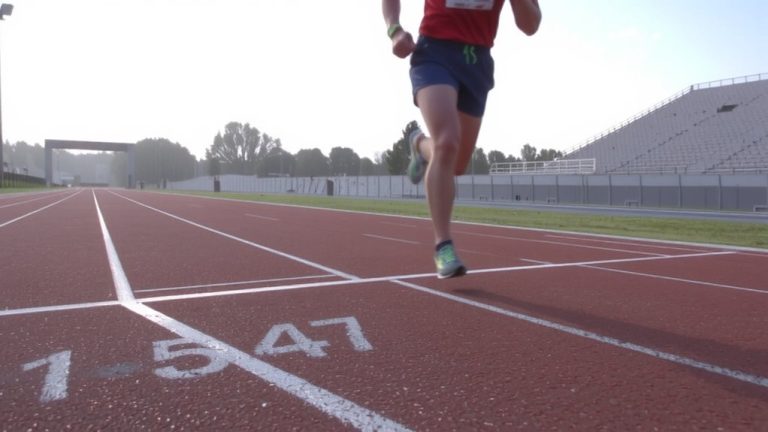
Though you’re covering ground fast, it’s not just your legs doing the work-your nervous system’s getting primed with every 200m sprint you crush at 95–100% effort. Training at race pace with 200m sprints sharpens neuromuscular coordination and boosts neuromuscular power by demanding full type II fiber activation. You’re training at race intensity, which forces your ATP-PCr system and glycolytic energy pathways to respond under high intensities, mimicking late-race demands. With 4 × 200m at full throttle and 4-minute rests, you maximize motor unit synchronization and CNS recovery, so each rep stays crisp. This isn’t just speedwork-it’s nervous system tuning. You maintain stride mechanics under fatigue, especially from 170–200m, where most fade. Controlled, race-specific efforts improve intermuscular coordination and firing rates, ensuring your body delivers power efficiently. Train smart, stay fresh, and let your nervous system lead the sprint to the line.
On a final note
You’re building speed and resilience with 200m intervals, so stick with 3–4 minutes of rest to fully recharge your ATP-CP system. This sharpens neuromuscular firing, boosts stride efficiency, and activates fast-twitch fibers. Testers using Saucony Endorphin Speed 3s noted crisper shifts and less fatigue. Pair with 20g post-run whey protein, stay hydrated, and run on soft tracks when possible-your nerves, muscles, and joints will adapt faster, safely.