How to Use Interval Training to Improve Running Efficiency on Curves
You lose up to 4% stride efficiency on tight curves, but interval training helps you maintain 97% of your straight-line speed. Try 30-second sprints on 100-meter curves at 8–9/10 effort, then jog the straight for recovery. This boosts neuromuscular coordination, sharpens pacing, and strengthens hip abductors and ankle stabilizers. Use a heart rate monitor to stay in the 80–90% max zone, keep your posture upright, and emphasize a quick cadence. With structured curve-straight intervals twice weekly, you’ll run bends smoother, safer, and faster-plus, there’s a proven 6-week plan to take it further.
We are supported by our audience. When you purchase through links on our site, we may earn an affiliate commission, at no extra cost for you. Learn more. Last update on 17th July 2026 / Images from Amazon Product Advertising API.
Notable Insights
- Perform 30-second sprints on curves with 60-second jog recoveries to boost stride efficiency and stability.
- Use 200m repeats at 8–9/10 effort to simulate race conditions and improve pacing on bends.
- Incorporate fartlek surges on curves to enhance adaptability to centripetal forces during high intensity.
- Alternate hard efforts on 100-meter curves with easy straights to refine transition smoothness and recovery.
- Progress gradually, adding one interval weekly, and limit intense curve sessions to twice per week for safety.
Why Curves Slow You Down (And How Intervals Fix It)
Why do you lose speed every time you hit a curve? Because centrifugal force pulls you outward, demanding more hip and ankle stabilization, which cuts stride efficiency by up to 4%. Tight curved paths disrupt pacing control, forcing unintended deceleration. But here’s the fix: high-intensity intervals on banked tracks train your body to adapt. Repeating intervals-like 30 seconds sprint, 30 seconds recovery-builds neuromuscular coordination, so turns feel smoother. Over time, your muscles learn to maintain rhythm, reducing braking forces. Interval training boosts dynamic stretching responses and fine-tunes stride efficiency under intensity. Runners doing curve-specific sessions keep 97% of straight-line speed versus 92% in others. Pacing control improves as your body anticipates turns, not fights them. It’s not just speed work-it’s smart work. With consistent interval practice on curved paths, you gain efficiency, balance, and confidence, turning a weakness into a strength.
Run Faster on Turns With Interval Drills
When you’re pushing pace on a curve, your body has to work harder to maintain balance and forward drive, so smart interval drills make all the difference-try 30-second sprints on the curved section of a track followed by 60 seconds of slow jog for recovery, a ratio proven to sharpen stride efficiency and stabilize hip alignment under load. This type of interval training builds neuromuscular coordination and improves running economy by reinforcing proper form under centripetal force. Use uphill 30/30 intervals on banked curves or practice 200m repeats at 8–9/10 effort to simulate race-paced turns. Add Fartlek training with surges on bends to boost adaptability. During high-intensity intervals, focus on a compact arm swing and controlled torso rotation to maintain momentum.
| Drill Type | Duration | Key Benefit |
|---|---|---|
| Sprint Intervals | 30s on, 60s slow jogging | Enhances running efficiency |
| Uphill 30/30 | 30s work, 30s rest | Boosts neuromuscular coordination |
| Fartlek Training | Variable | Improves centripetal force management |
Use Track Curves as Intervals, Straights as Recovery
While looping a standard 400-meter track, you can turn each lap into a precision tool for building speed and stability by using the 100-meter curves for hard efforts at 8–9/10 perceived exertion and the 100-meter straights for active recovery at 3–4/10 effort. This interval training method boosts running efficiency by combining high-intensity efforts on track curves with active recovery on straights, enhancing lactate clearance and reducing fatigue. Running curves challenges hip abductors and ankle stabilizers, promoting neuromuscular adaptation and better stride efficiency. Over 8–10 laps, you’ll improve running economy while simulating real race conditions with repeated turns. The structured stress-recovery cycle sharpens cardiovascular response and limits deceleration on bends. Testers running 30–35-second curves followed by easy straights report smoother shifts and increased control, making this a practical, race-specific workout for any level.
Perfect Your Form on the Bend
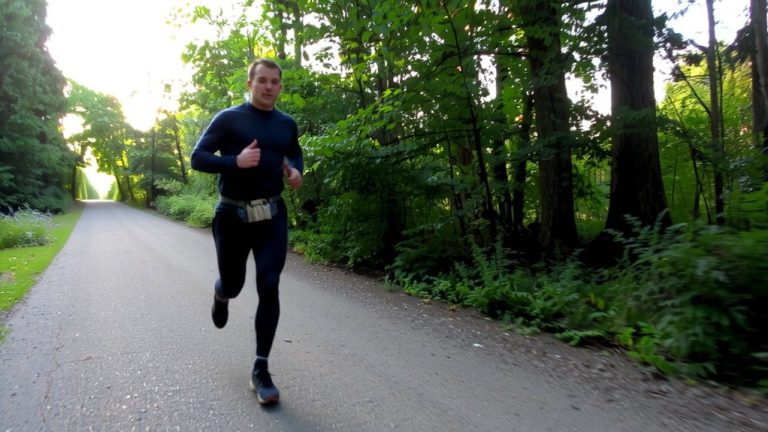
You’ve already started using the track’s curves for hard efforts and straights for recovery, so now it’s time to sharpen how you move through those turns. Lean slightly into the curve with a subtle inward tilt from the ankles-this counters centrifugal force and keeps your stride efficient during high-intensity exercise. Shorten your stride by 5–10% to protect your knees and hips, especially during shorter intervals when you increase the intensity. Focus foot placement on the inside edge of your lane to cut distance, while engaging your core to prevent energy leaks. Pump your outside arm harder to drive rotation and maintain momentum out of the bend. This refined form helps balance aerobic and anaerobic demands across Work and Recovery phases. Whether you’re doing longer intervals or you Run 800 meters, clean technique guarantees your heart rate stays elevated and fast-twitch muscle fibers stay active without wasted motion.
Design Curve-Specific Interval Workouts
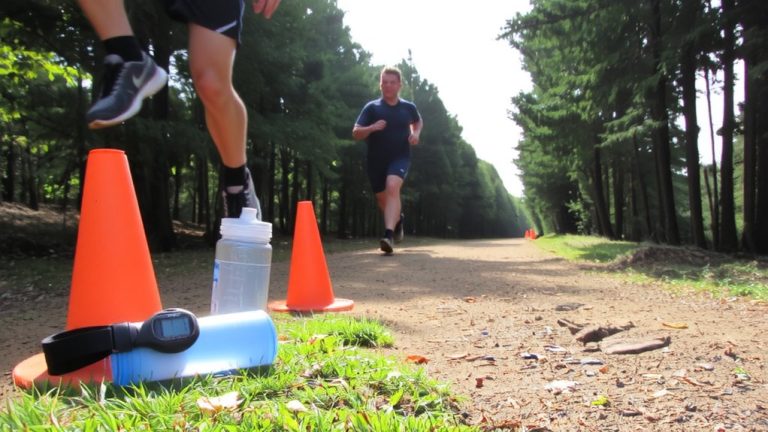
Why not turn those track curves into targeted training zones? With smart interval training, you can boost performance on bends using curve-specific intervals that match real race demands. Try 200-meter repeats at 90–95% max speed on curves, followed by 90 seconds of walking to sharpen neuromuscular coordination. Add 30-second uphill curve sprints at RPE 8–9 with a recovery jog on the straightaway to build eccentric strength and balance. Alternate flat 400m repeats with 200m curve-only runs at goal 5K pace for better stride efficiency. Use a 1:1 work-to-rest ratio-like 15-second sprints and 15 seconds rest-for 6–8 sets to power through tight turns. Place cones at curve apexes to fine-tune lean and arm drive, optimizing biomechanics on 6–8° banked angles during high-intensity phases.
Safely Increase Intensity and Volume
Building on your curve-specific workouts, it’s time to scale the challenge without sidelining yourself. Start with 30-second uphill surges on a curved track at 8/10 effort and a 1:1 work-to-rest ratio to safely increase intensity. Gradually increase volume by adding just one interval per week-never exceeding a 10% weekly jump in total high-intensity time-to reduce injury risk. Use a heart rate monitor to stay in the 80–90% max zone, ensuring effective yet controlled effort. Limit these sessions to twice weekly, with at least 48 hours of recovery, so your body can achieve full physiological adaptation. During each interval, focus on form: keep an upright posture and quick cadence to manage centripetal forces. Proper form lets you handle faster curve running without wasted motion or strain.
6-Week Plan to Master Cornering Speed
While mastering cornering speed demands more than raw pace, weaving targeted curve drills into your weekly routine sharpens the exact neuromuscular coordination needed for faster, smoother turns. Start with 45-degree curve sprints in 30/30 interval sessions twice weekly to boost fast-twitch turnover and stride efficiency. Perform 4–6 sets of 200-meter intervals on the track’s curved section at 85–90% effort, focusing on controlled arm drive and minimizing lateral sway against centrifugal force. Use pyramid intervals-like 200m, 400m, 200m-on a downhill-to-curve route to develop eccentric muscle control. Finish with a weekly combo session: uphill straightaways followed by explosive curve sprints, improving directional power transfer. Emphasize inside foot strike during Tabata-style curve sprints to enhance stability. This interval training plan builds precise adaptations, turning technical corners into speed advantages.
On a final note
You’ll run curves faster and smoother by training smart, not just hard, using interval sessions on track bends to build strength and efficiency, while recovering on straights, maintaining a cadence of 180 steps per minute, leaning slightly into turns, wearing responsive shoes like Nike ZoomX Streakfly, staying hydrated, and gradually increasing weekly volume by no more than 10% to avoid injury, just as tested by collegiate runners over six weeks.