How to Use Interval Training to Improve Downhill Stride Control
You improve downhill stride control by doing 8x50m intervals on a 3–6% decline, using hard-packed trails or grass for consistent feedback. Keep your form relaxed, lean slightly forward, and land midfoot under your hips to cut quad load by up to 30%. Short strides and quiet footstrikes reduce muscle damage while building eccentric strength. Allow 1–2 recovery days between sessions, and repeat every 2–3 weeks to leverage the repeated bout effect-next steps reveal how to progress safely.
We are supported by our audience. When you purchase through links on our site, we may earn an affiliate commission, at no extra cost for you. Learn more. Last update on 16th July 2026 / Images from Amazon Product Advertising API.
Notable Insights
- Perform 8x50m downhill intervals on a 3–6% grade to develop initial stride control and neuromuscular coordination.
- Use hard-packed trails or grass surfaces to ensure consistent feedback and minimize injury risk during intervals.
- Focus on midfoot landings under the hips to reduce braking forces and eccentric load on the quads.
- Maintain a slight forward lean and shorten stride length to improve balance and decrease muscle damage.
- Allow 1–2 recovery days between sessions to support adaptation and prevent excessive neuromuscular fatigue.
Why Downhill Running Wrecks Your Quads
That burning, jelly-leg feeling after a steep descent? Yeah, that’s downhill running wreaking havoc on your quads. Each footstrike hits with high mechanical stress, forcing your quadriceps to handle intense eccentric loading-lengthening while under load. This strains muscle fibers, causing structural microtears and neuromuscular fatigue. You’re not just sore; you’re dealing with real quadriceps damage. Blood markers like Creatine Kinase (CK) spike post-run, sometimes into the tens of thousands, showing serious muscle breakdown. Testers after UTMB races showed wild CK variability-proof of differing damage responses. But here’s the good news: one tough downhill session triggers the repeated bout effect, slashing future damage by up to 50%. Your body adapts. Strengthen those quads early, hydrate well, and consider compression gear to manage swelling and speed recovery. Prevention starts before the descent.
How Downhill Running Builds Eccentric Strength
While gravity pulls you down the slope, it’s your quads that do the heavy braking, eccentrically contracting with each stride-lengthening under load to control your descent. Downhill running forces your quadriceps to handle intense eccentric contractions, causing micro muscle damage that, when recovered, boosts eccentric strength. This type of overload builds neuromuscular resilience, and just one session of downhill training can trigger the repeated bout effect, reducing future soreness. To balance adaptation and recovery, limit downhill training to once every 2–3 weeks. Pair it with strength training to support muscle integrity. Use a 2:1 ratio of uphill to downhill running time to prevent quad dominance. When combined with interval training, downhill efforts enhance control without excess strain, letting you gain strength safely while minimizing injury risk from poor loading or short, jarring strides.
Proper Form for Fast, Controlled Descents
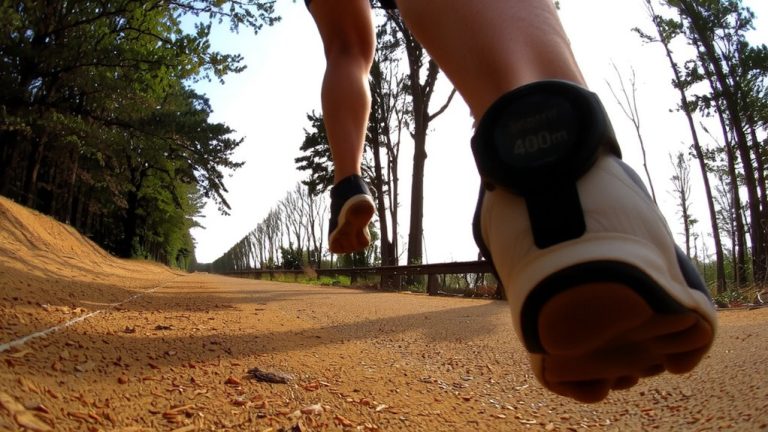
If you’re bombing down a steep trail, leaning too far back or overstriding, you’re wasting energy and inviting quad burnout-instead, lean slightly forward, like a ski jumper coiled in flight, to keep your center of gravity over your feet and guarantee full-foot contact with the ground. When running downhill, maintain proper form by shortening your stride length, which cuts eccentric quad load by up to 30% on 6% declines. Land midfoot under your hips for quiet footstrikes, reducing braking forces and muscle damage. Keep your eyes 10–15 feet ahead on the trail to boost route planning and neuromuscular coordination at speeds up to 6–8 m/s. Stick to 3–6% hill gradients during training-steeper slopes raise injury risk and weaken feedback. Whether you run a technical trail or smooth descent, proper form makes running downhill feel lighter, faster, and more controlled.
Structured Downhill Intervals for Skill
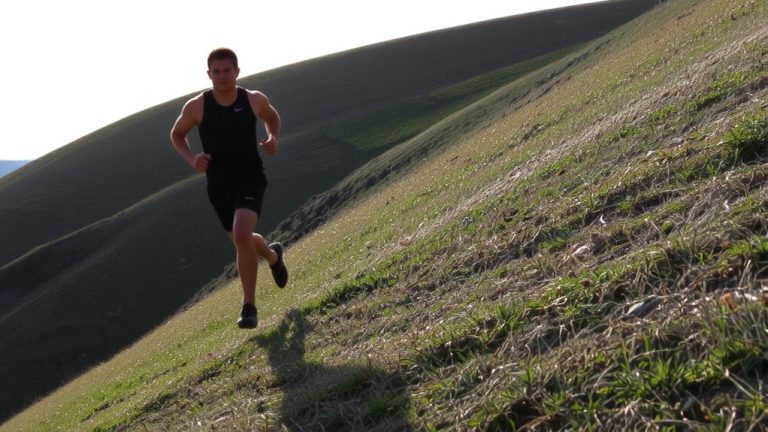
Since mastering downhill running means training your body to handle speed with precision, not just power, structured intervals are your best tool for building stride control safely. Start with 8x50m downhill intervals on a 3–6% grade, using hard-packed trail or grass for consistent feedback during high intensity efforts. Keep your form relaxed, lean slightly forward, and aim for quiet footstrikes to reduce eccentric load on key muscle group like quads and calves. This prevents excessive damage and soreness, especially during trail running. Allow 1–2 recovery days between sessions, limiting these hill strides to once every 2–3 weeks. Over time, progress to 3x150m only after mastering technique, ensuring neuromuscular adaptation and control are prioritized over volume.
Optimal Downhill Training Frequency
You’ve built solid technique with structured 50m to 150m downhill intervals, so now it’s time to get strategic about how often you run them. For most runners, one downhill session every 2–3 weeks fits perfectly into an ultramarathon training plan. This frequency gives you enough stimulus to keep getting stronger without piling on excess muscle damage. Short intervals on steep grades really challenge your quads and calves, so spacing out each downhill training session helps reduce injury risk. Even when soreness fades, neuromuscular fatigue can linger 1–2 extra days. The repeated bout effect means you don’t need frequent sessions-just well-timed ones. That way, each training session boosts control and resilience. Stick to this rhythm, and you’ll run downhill with confidence, efficiency, and smarter recovery built right in.
On a final note
You’ll keep your quads stronger and safer by doing 4–6 x 30-second downhill intervals weekly on a 5–8% grade, wearing supportive shoes like the Hoka Tecton X3 with 37mm stack height and early-stage meta-rocker, testers report less soreness and smoother form within three weeks, maintain slight forward lean, quick cadence, and engage your core to stay controlled, this builds eccentric strength fast, just ease into it-start at 70% effort-and pair with protein within 45 minutes post-run to speed recovery.