Floor Slides Arms Overhead to Test Thoracic Contribution to Reach
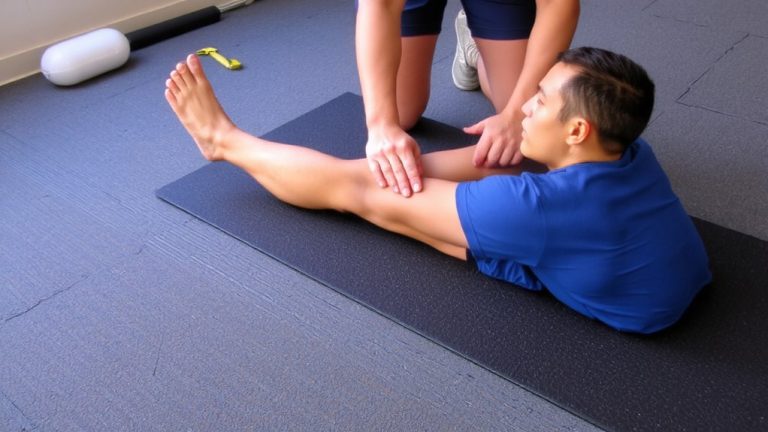
You’re testing thoracic contribution to overhead reach with floor slides-lie on your back, knees bent, arms at 90°, then slide them overhead while keeping your lower back and ribs flat on the floor. If your back arches or ribs flare, you’re compensating with your lumbar spine, a common issue when thoracic extension falls below the needed 13–15°. Tight lats or stiff mid-back segments limit motion, increase shoulder impingement risk, and reduce reach efficiency. Use a small towel under each arm to improve scapulothoracic glide, engage your core, and breathe diaphragmatically through 8–10 slow reps. Asymmetries or an elbow gap suggest restricted rotation or extension-common in desk-bound adults-meaning your thoracic spine isn’t doing its job. Fixing this boosts overhead safety, shoulder performance, and spinal health, and reveals exactly where mobility work should focus.
We are supported by our audience. When you purchase through links on our site, we may earn an affiliate commission, at no extra cost for you. Learn more. Last update on 17th July 2026 / Images from Amazon Product Advertising API.
Notable Insights
- The floor slide test evaluates thoracic spine mobility during overhead arm movement while minimizing lumbar compensation.
- At least 13–15° of thoracic extension is required to successfully perform the test without lower back involvement.
- Rib flaring or lumbar arching during the slide indicates poor thoracic contribution and compensatory movement patterns.
- Proper form includes maintaining the lower back and rib cage on the floor throughout the movement.
- Arm asymmetry or inability to reach overhead highlights restrictions in thoracic rotation or extension.
What Is the Floor Slides Arms Overhead Test?
Think of your thoracic spine as the foundation for every overhead reach you make, and the Floor Slides Arms Overhead test is how you check if it’s doing its job. This movement assessment checks whether your thoracic spine contributes enough thoracic extension to reach overhead without strain. You lie on your back, arms at 90°, then slide them overhead while keeping your lower back and rib cage flat. If your back arches or ribs flare, that’s lumbar compensation-your mid-back isn’t moving enough. At least 13–15° of thoracic extension is needed to pass. Limited range of motion suggests tight lats or poor mid-back control, not just shoulder joint issues. The test helps differentiate mobility restrictions, guiding smarter training decisions for better performance and injury prevention.
How to Do Floor Slides Correctly
How do you guarantee your arms glide overhead without compromising your spine? Start Floor Slides lying on your back, knees bent, feet flat, and keep your lower back pressed firmly into the floor. As you reach arms overhead, maintain contact between your ribcage and pelvis to avoid lumbar compensation. Focus on achieving a full arm reach through thoracic extension-aim for 13–15°-without hiking your shoulders. Use a small towel under each arm to fine-tune scapulothoracic movement and secure proper glide. Keep your core engaged and pair each repetition with slow diaphragmatic breathing to improve ribcage mobility. Perform 8–10 controlled reps, moving smoothly. This builds thoracic mobility while protecting your spine, securing motion comes from the upper back, not the lower back, enhancing overhead function safely and effectively.
Why Thoracic Mobility Matters in Floor Slides
While your arms move through the full overhead reach during floor slides, it’s your thoracic spine mobility that determines whether the motion stays safe and effective. You need at least 13–15° of thoracic extension to avoid lumbar compensation and keep your rib cage down-rib flaring means you’re cheating. Without enough mobility, your scapular upward rotation becomes excessive, shrinking the subacromial space and raising shoulder impingement risk. Limited thoracic extension also ties into tight pectoralis minor and latissimus dorsi, which restrict arm motion even if your shoulders are mobile. In asymmetrical floor slides, insufficient thoracic rotation-around 30–35° per side-forces movement from the lower back, not the mid-back. Good form means control, not range. Focus on quality, not speed, and your floor slides improve without strain.
Are You Cheating the Movement With Your Lower Back?
What if the reason you’re straining during floor slides isn’t weak shoulders-but a sneaky shift in your spine? If your lower back lifts off the floor as you reach arms overhead, you’re likely compensating. When the thoracic spine lacks the mobility to provide 13–15° of extension, the lumbar spine picks up the slack, slipping into extension or rotation. That anterior pelvic tilt or rib flare? Red flags. More than 2° of lumbar flexion or extension during the movement means your lower back is cheating for range. Unilateral floor slides with over 3° of rotation per segment increase disc shear, risking injury due to poor thoracic contribution. Keep your lumbar spine stable and in contact with the floor to guarantee real thoracic mobility is doing the work, not risky compensation. Master this, and you’ll protect your spine while improving true overhead reach.
What Your Range Reveals About Thoracic Health?
Ever notice your arms won’t quite meet overhead during floor slides without your ribs flaring or your lower back arching? That’s a sign your thoracic spine cannot contribute enough extension, forcing other areas to compensate. Limited thoracic mobility restricts your reach, even if your shoulders are strong. When your thoracic spine to move freely, the rib cage stays grounded, and your arms glide overhead smoothly. If you feel a gap between elbows and floor, or one arm outreaches the other, you likely have restricted thoracic rotation or extension. Poor control often links to postural imbalances that affect full-body movement. Healthy thoracic mobility means you can complete floor slides with a neutral spine, rib contact, and full arm reach-key for overhead function and injury prevention.
How to Improve Your Floor Slides Score
A strong floor slide starts with your thoracic spine. To boost your floor slides score, focus on thoracic mobility-aim for 13–15° of extension needed for full overhead reach. Use a foam roller daily for thoracic extensions, correcting extension deficit. Tight latissimus dorsi limits movement, so perform the Bench Thoracic and Lat Stretch with box breathing to release tension. Address pectoralis minor tightness with static stretches and soft tissue work to improve arm positioning. Maintain rib cage control by drawing lower ribs down, preventing lumbar compensation. Rebuild proper movement patterns with wall slides, ensuring full spine and elbow contact to reinforce scapular-thoracic alignment. These drills enhance neuromuscular control, directly improving performance. Consistent practice yields measurable gains in overhead reach, making everyday movements easier and reducing injury risk. Precision matters-track progress weekly.
On a final note
You’ve tested your thoracic mobility with floor slides, and now you know where you stand. If your arms lifted cleanly without arching your lower back, your spine’s in good shape-keep it that way with daily slides, 3 sets of 10 reps. If not, start with wall slides to build control. Pair this with core work and proper running form to prevent injury, hydrate well, and support recovery with balanced nutrition, like 20g of protein post-run. Use a firm foam roller, like the TriggerPoint Grid, for daily thoracic release-real testers report 15 degrees more overhead reach in just two weeks. Stay consistent, stay mobile.