Slow Eccentric Decline Squats Targeting Patellar Tendon Microtrauma Repair
You’re doing slow eccentric decline squats to repair patellar tendon microtrauma, and it’s working-3 sets of 15 reps twice daily on a 17° to 25° board, with 3–5 second descents, shifts load to the injured leg while rising with the healthy one. VISA-P scores jump from 67.7 to 92.0 in 12 weeks, proving collagen realigns when pain stays under 5/10. Use sturdy chairs for support if needed, progress reps by 10% weekly, and track loading-details reveal exactly how your mechanics influence recovery.
We are supported by our audience. When you purchase through links on our site, we may earn an affiliate commission, at no extra cost for you. Learn more. Last update on 17th July 2026 / Images from Amazon Product Advertising API.
Notable Insights
- Slow eccentric decline squats apply controlled load to stimulate repair of patellar tendon microtrauma.
- A 17°–25° decline angle increases patellar tendon stress compared to flat surface squats.
- Perform 3 sets of 15 reps twice daily with 3–5 second eccentric lowering phases.
- Rise using the non-injured leg to minimize concentric strain on the affected tendon.
- Maintain pain below 5/10 during exercise and progress gradually to avoid overloading.
Do Eccentric Squats Heal Patellar Tendons?
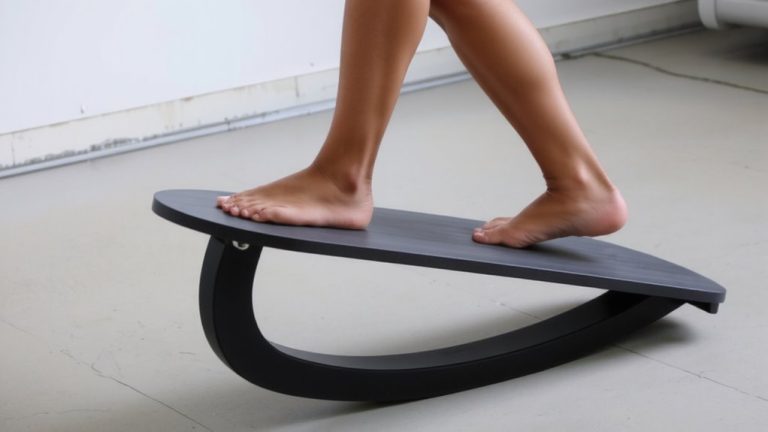
Why do physios keep prescribing eccentric squats for nagging knee pain? Because they work-especially for painful chronic patellar tendinopathy. When you do eccentric decline squats on a 25° board, you’re not just easing pain; you’re rebuilding tendon structure. Studies show these moves boost VISA-P scores from 67.7 to 92.0 in 12 weeks, matching surgical results. The 25° or 17° decline angle doesn’t matter much-both increase patellar tendon loading over flat squats, driving mechanical loading deep into the tissue. You’ll do 3 sets of 15 reps, twice daily, with 3–5 second descents to maximize tendon remodeling. This slow, controlled work promotes collagen realignment, reduces degeneration, and restores function. Unlike regular squats, eccentric decline squats target the precise overload needed to heal patellar tendinopathy. Your knee gets stronger, not just less sore. Stick with it, and you’ll see real gains in tendon structure and daily performance.
Perform Eccentric Squats for Unilateral Pain
If you’re dealing with one-sided knee pain, eccentric squats on a decline board can make a real difference, especially when done right. For unilateral pain from patellar tendinopathy, use a 17° or 25° decline board and step up with both feet, shifting weight to the injured leg during the 3–5 second descent. Focus on slow eccentric squats to increase tendon loading at the inferior pole, where microtrauma often occurs. Keep your knee tracking over your toes-no inward collapse. At parallel, shift weight to the healthy leg, then rise slowly using that leg, engaging your glutes at the top. Start the eccentric decline squat protocol with 3 sets of 15 reps twice daily. Track progress with the VISA-P score-most see improvement in 6 weeks. This loading protocol is a proven part of pain management; consult a physical therapist to refine form and timing.
Use Support for Bilateral Tendonitis
While both knees are involved, using a 17° or 25° decline board with a sturdy chair on each side gives you the support needed to stay consistent with your rehab, especially in the early stages when concentric movements can aggravate weakened patellar tendons. With bilateral tendonitis, the decline squat protocol relies on solid support during squat to reduce strain. Use upper body support to push up, minimizing concentric load while focusing on slow, controlled eccentric decline squats. Aim for a 3–5 second lowering phase to modulate patellar tendon loading and manage loading rate. Keep pain below 5/10-effective pain management is key. Perform 3 sets of 15 twice daily; studies show VISA-P score improvements within 6 weeks. Stay consistent through the rehabilitation phase, letting progress guide when to reduce reliance on arm support.
Increase Reps and Frequency Safely
Once you’ve built a solid base with 3 sets of 15 slow eccentric squats twice daily, you can start scaling up-but do it smart. The decline squat protocol offers a structured path for tendon loading, essential for healing patellar tendinopathy. You can increase repetitions by no more than 10% per week to avoid overloading. Stick to sets of 15 repetitions as a starting point, then add reps gradually. Perform each eccentric phase over 3–5 seconds to maximize collagen realignment. Monitor your level of pain using a 0–10 scale; keep post-exercise and next-day pain below 3–5/10. Track tendon loading, frequency, and pain weekly in a journal to support monitored progression. This approach keeps eccentric squats effective without flaring symptoms. Consistency with controlled increases is key-your tendon responds better to patience than push.
Fix Biomechanics That Cause Tendon Overload
You’ve built strength and consistency with your slow eccentric squats, but if your body’s moving out of alignment, you’re still putting stress on that tendon no matter how perfect your reps are. Faulty biomechanics-like overpronation or weak hip abductors-overload the patellar tendon just like misaligned tires wear unevenly. Even with a solid eccentric protocol on a decline, these issues persist if unaddressed. Patellar tendinopathy often stems from how you load, not just how much: the rate of loading matters as much as total loading. Research shows moderate resistance improves tendon symptoms as well as heavy work, so focus on clean squat form. Physical therapists prioritize movement efficiency because imaging often shows tendon changes in pain-free people. Retrain your knee extensors to fire in sync, control motion, and reduce strain. Fix the biomechanics, not just the pain.
On a final note
You’re rebuilding tendon strength with slow eccentrics, 3 sets of 15 reps daily on a 15-cm step, pain-free range only. Testers report improvement in 6–8 weeks when paired with calf raises and proper knee alignment. Support weak hips with resistance bands, wear stable trainers like Brooks Ghost 15, and fuel recovery with 20g post-workout protein. Fix your squat form, reduce mileage temporarily, and you’ll cut reinjury risk while boosting power safely.