Best Hip Hinge Exercises
You’ll build serious posterior chain strength with these hip hinge moves: Romanian deadlifts for hamstrings, barbell hip thrusts to max out glute activation, and kettlebell swings for explosive power. Start with bodyweight hinges or banded drills to lock in form, then progress to dumbbell or barbell work. Keep your spine neutral, hinge at the hips, and avoid rounding your back. Add in glute bridges as a warm-up to fire up the right muscles and protect your low back-consistency here means stronger, safer movement every time, and better results the more you refine your technique.
We are supported by our audience. When you purchase through links on our site, we may earn an affiliate commission, at no extra cost for you. Learn more. Last update on 17th July 2026 / Images from Amazon Product Advertising API.
Notable Insights
- Romanian deadlifts maximize hamstring development through controlled eccentric loading with proper hip hinge form.
- Barbell hip thrusts deliver peak glute activation at full hip extension for superior posterior chain strength.
- Kettlebell swings build explosive power while enhancing glute and spinal erector engagement safely.
- Good mornings strengthen erector spinae with axial loading, improving spinal endurance and hinge mechanics.
- Staggered stance RDLs reduce lower back strain, making them ideal for those with back pain.
What Is a Hip Hinge and Why It Matters
Think of the hip hinge as your body’s natural forklift, designed to move weight safely and efficiently. This fundamental movement pattern involves hinging at the hips while keeping a neutral spine position, protecting your lower back pain risk. Instead of bending at the waist, you’re properly loading the posterior chain-glutes, hamstrings, and erector spinae-making it essential for strength training and daily life. Using proper form reduces the risk of injury, especially under load. Research confirms it lowers spinal compression, improving trunk control and balance. Whether you’re lifting groceries or mastering deadlifts, mastering the hip hinge matters. Cues like a wooden dowel along your spine or resistance bands at the pelvis reinforce correct mechanics. It’s not just gym work-it’s movement longevity, backed by science, built for real-world demands, and critical for staying pain-free and strong.
Best Hip Hinge Exercises by Muscle Focus and Goal
Why do some hip hinge variations leave you feeling powerful while others strain your back or miss the mark entirely? It comes down to matching the exercise to your muscle focus and goal. For hamstring development, the Romanian deadlift reigns supreme-minimal knee flexion and hip-dominant movement maximize eccentric loading. Want glute activation? The barbell hip thrust delivers peak contraction at full hip extension, sparing your lower back. If you’re building posterior chain endurance, the good morning strengthens spinal erectors with axial loading. Need power? The kettlebell swing generates force beyond its weight, spiking glute and back engagement. And if you have lower back pain, the staggered stance RDL reduces strain while keeping hamstring and glute focus. Master each hip hinge movement to target what matters most.
How to Progress From Beginner to Advanced Safely
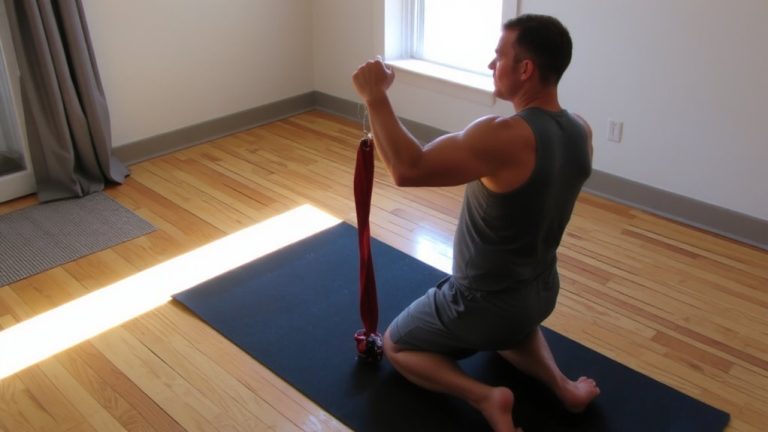
While mastering the hip hinge starts with learning the movement pattern, building strength safely means progressing step by step-starting with no load at all. Begin with bodyweight drills like hand-sliding hinges to hip hinge correctly and train hip posterior displacement while keeping your spine neutral. This hinge is a fundamental pattern, so nail form before adding resistance. Next, move to resistance band hip hinges or kettlebell swings to reinforce motor control with minimal spinal load. Then try goblet hip hinges or Romanian deadlift with light dumbbells, focusing on a neutral spine throughout. As you advance, introduce a loaded barbell-start with barbell Romanian deadlift before attempting a full barbell deadlift. Only progress when you can maintain form across full range, as improper hip hinges raise injury risk. Use wearable sensors or video feedback to monitor spine position and guide safe progression.
When and How to Program Hip Hinge Exercises
How do you make sure your hip hinge training actually delivers results without setting you up for injury? Start by programming hip hinges smartly. Prioritize compound hip hinge lifts like the barbell deadlift and Romanian deadlift early in your workout-they demand high neural drive and build serious posterior chain strength. Use movement-specific drills such as glute bridges or banded hinges for warm-up activation to prime your glutes and hamstrings. This boosts movement efficiency and reduces lower back strain. Follow a clear strength progression: master bodyweight hinging before adding load. Tools like wearable sensors feedback help maintain a neutral spine, cutting injury risk. According to Kim & Yim (2020), hip hinge exercises even aid those with low back pain. Program them weekly, track form, and progress with purpose-your body will adapt safely and powerfully over time, movement by movement.
On a final note
You’ve got this: master the hip hinge to build stronger glutes, hamstrings, and lower back while reducing injury risk. Start with bodyweight deadlifts, progress to barbell variations like Romanian deadlifts at 60–75% 1RM for 3–4 sets of 8–10 reps, and use a mat for joint comfort. Pair smart training with real-world gear-like supportive shoes and form mirrors-and fuel workouts with 20g protein post-session. Consistency beats intensity, every time.