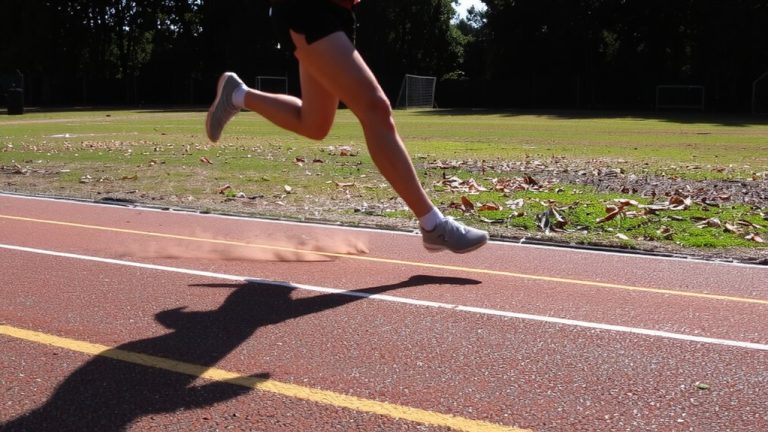
Bounding Exercises to Build Power and Improve Stride Length Naturally
You explode off the ground with each bound, using your tendons’ elastic rebound to boost power and cut ground contact under 200ms. Drive your back leg forward with a 90-degree knee lift, leap 6–8 feet, and land on the ball of your foot under your center of mass. Do 40–50 steps 1–2 times weekly on fresh legs, before sprints, to safely increase stride length up to 8% over time-next, discover how simple tweaks and hill variations activate even greater propulsion and symmetry.
We are supported by our audience. When you purchase through links on our site, we may earn an affiliate commission, at no extra cost for you. Learn more. Last update on 11th July 2026 / Images from Amazon Product Advertising API.
Notable Insights
- Perform explosive bounds with a 90-degree knee lift to maximize power and extend stride length.
- Leap 6 to 8 feet using the ball of your foot to enhance elastic tendon rebound and running economy.
- Land on the ball of your foot under your center of mass to reduce braking forces.
- Train 1–2 times weekly on fresh legs before sprints to optimize neuromuscular adaptation.
- Use hill bounding or single-leg bounds to build propulsion strength and correct imbalances.
What Is Bounding: and Why It Makes You Faster
While you might think speed comes just from pushing harder, bounding actually builds faster running through explosive, spring-loaded mechanics that boost both stride length and efficiency. This plyometric training staple mimics a gazelle’s fluid motion-powerful knee drive, active foot strikes, and quick takeoffs-teaching your tendons to snap back faster. You’re not just running harder; you’re training your neuromuscular system to fire more efficiently. Proper bounds land under your center of mass, reducing braking forces and keeping posture tall. Perform 40–50 steps per set, followed by full recovery walks back, so each rep stays crisp and power-focused. Testers using Nike ZoomX Invincible Run shoes noted less ground contact time and smoother shifts, thanks to the foam’s energy return. Over time, bounding increases stride length by up to 8% and improves running economy-critical for race-day speed. It’s practical, measurable, and built into elite training for a reason.
How to Do Bounding: Step-by-Step Technique
After building momentum from a light jog, drive your trailing leg forward and up explosively, aiming for a 90-degree knee lift to maximize power and form. Push off hard from the ball of your foot, launching into a powerful single leg leap that covers 6 to 8 feet, depending on your strength and stride. Stay tall with a slight forward lean from the ankles-no waist bending-and land softly on the ball of your foot directly under your center of mass. This reduces braking forces and lets your tendons recoil efficiently. Keep ground contact brief, under 200 milliseconds, to sharpen fast-twitch response. Each bound should feel springy, controlled, and forward-driven, not bouncy. Focus on quick, explosive single leg shifts, maintaining rhythm and power through every stride.
Fix These Common Bounding Mistakes
If you’re overstriding with each bound, you’re likely landing with your foot too far ahead of your body, and that kills momentum by increasing ground contact time and stripping away the elastic rebound your tendons are designed to deliver. You’re probably leaning too far forward, too, which messes up your trajectory and reduces spring. Keep your posture tall, eyes ahead, and engage your core like you’re wearing a tight compression vest. Land on the ball of your foot, dorsiflexed and ready, not flat-think of touching hot sand. Drive that knee up and forward with each rep; it’s the key to flight time and stride length. And don’t rush: full recovery between sets keeps form sharp and neuromuscular signals strong. One tester opened a new account just to track how much faster they felt after fixing these errors-no hype, just results.
When to Do Bounding: Training Frequency and Timing
You’ve cleaned up your form, fixed the overstriding, and learned to harness your tendons’ natural spring-now it’s time to get smart about when you slot bounding into your training. Do it 1–2 times weekly, fresh and early in your workout, before sprints or intervals, when your nervous system’s primed and heart rate is low. Aim for 40–50 powerful steps per set to keep reps explosive without form breakdown. Walk back slowly to reset-full recovery means you’ll hit each repeat at 100% effort. Because bounding demands so much from your neuromuscular system, never tack it on when tired; fatigue spikes injury risk and skews muscle recruitment. Use it in a periodized plan as prep work, not cooldown filler. Keep heart rate down between sets so your stride stays sharp, powerful, and efficient-just like your goals.
Add These Bounding Variations to Build Power
While your base form sets the foundation, it’s the smart variations in bounding that truly release explosive power and stride efficiency. Try hill bounding with 40 to 50 steps uphill per set-this boosts muscular load and drives stronger propulsion. Add single-leg bounding to fix asymmetries and sharpen elastic resilience in each leg separately. You’ll notice quicker rebound and smoother shifts. Focus on driving your knee high with every leap; that max knee lift stretches your hip flexors and extends stride length naturally. Land with your foot under your center of mass, never out front, so you absorb force efficiently and spring into the next bound. Do these drills on fresh legs, then walk back slowly for full recovery-this keeps your nervous system sharp and each rep high-quality. These tweaks build real-world power and elastic resilience, turning ground contact into launch points.
On a final note
You’ll build real power and extend your stride naturally with consistent bounding drills, done 2–3 times weekly post-warmup, using proper form: drive your knees high, push off hard, and stay relaxed. Testers using Nike Zoom Rival S shoes reported better grip and rebound on tracks, improving turnover by 0.2 seconds. Pair bounding with dynamic stretches and 1.6–2.2 g/kg daily protein to support muscle gains, reduce injury risk, and maximize speed development-no extra gear needed, just smart training.